
Beneficial organisms
The beneficial organisms of the agro-ecosystem: pollinators, predators of other insects and worms that work the soil. Each entry explains their role, their link with the crop and their pace of life, with sources and a free-licence photo.
These entries describe the life of the organisms; they are neither a treatment nor a recommendation for use. This is a pilot of six organisms, to be extended.
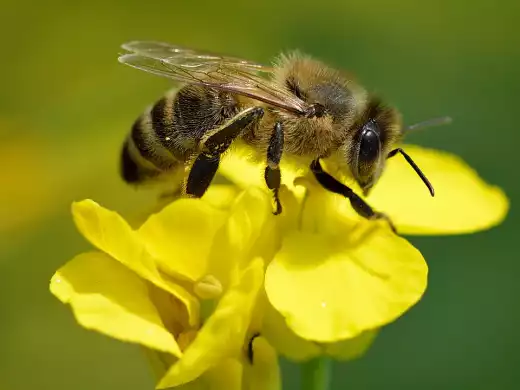
 Honey bee — Apis mellifera
Its role. Pollinating insect: it moves from flower to flower collecting nectar and pollen, and so carries pollen between the flowers of crops and wild plants.
Link with the agro-ecosystem. FAO states that over 75% of the world's major crops depend on pollination, and that pollinating insect populations are declining, among other causes through habitat loss and indiscriminate pesticide use. Unlike bumble bees, the honey bee does not perform buzz pollination.
Pace of life. Three castes: worker, queen and drone (male). Egg to adult takes 21 days for a worker, 24 for a drone and 16 for a queen; the egg (about 1/16 inch) hatches after 3 days and the cell is capped when the larva starts to pupate. A fertilised egg becomes a female (worker or queen), an unfertilised one a drone. According to the source, most queens can lay up to 1500 eggs a day. Swarming happens in mid-spring with a new queen; in winter the bees cluster at the centre of the nest, eat honey and shiver their flight muscles to make heat, and brood rearing usually restarts after the winter solstice.
Sources : Global Action on Pollination Services for Sustainable Agriculture — News (FAO) · Bumble bee pollination in tomato greenhouses (ENT-0092) (Ohio State University, CFAES) · The Honey Bees' World (First Lessons in Beekeeping, ch. 2) (LSU Entomology)

 Buff-tailed bumblebee — Bombus terrestris
Its role. Pollinator that grips the flower and vibrates its thoracic muscles at very high frequency: the vibration shakes the pollen loose, it stays on the bee's fur and moves on to other flowers (buzz pollination).
Link with the agro-ecosystem. Tomato produces no nectar: its only floral reward is pollen. Bumble bees have been used in tomato greenhouses since 1985, when they were shown to replace manual pollination, which required shaking the plants three times a week. A commercial box holds a mated queen and about 100 workers; the source cites 7 to 15 colonies per hectare, and too many colonies can cause over-pollination.
Pace of life. Annual cycle: in the wild the queen emerges from hibernation in spring, forages and lays eggs; the first workers appear about 3 to 4 weeks later. At the end of the cycle new queens and males are born and the colony dies before winter; the newly mated queens store sperm over winter. A commercial colony lasts 10 to 14 weeks.
Sources : Bumble bee pollination in tomato greenhouses (ENT-0092) (Ohio State University, CFAES)
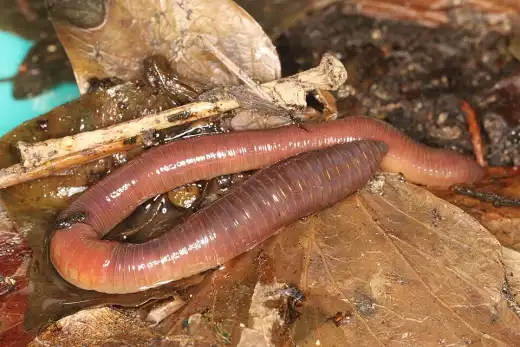
 Common earthworm (nightcrawler) — Lumbricus terrestris
Its role. Decomposer and “soil engineer”: it turns over the soil, buries plant residues and leaves casts that are more stable and richer in available nitrogen and carbon than the surrounding soil.
Link with the agro-ecosystem. According to the authors of the source (inland Pacific Northwest, USA), the vertical burrows of anecic worms can increase water infiltration and roots often grow through them; endogeic worms live in the top 6 to 8 inches and make horizontal burrows. Reduced or no tillage is associated with more worms, and anecic worms, large with deep burrows, are mostly found without tillage.
Pace of life. They are hermaphrodites and can produce from 3 to over 100 cocoons a year depending on species, conditions and food; they live 1 to 10 years according to the source. The source notes that densities above 400 per m² have the greatest measurable effect on plant growth; typical wheat fields in the region hold 50 to 200 per m².
Sources : Earthworms and their importance to agricultural soils in the inland Pacific Northwest (Crops & Soils, 2021) (ASA-CSSA-SSSA)
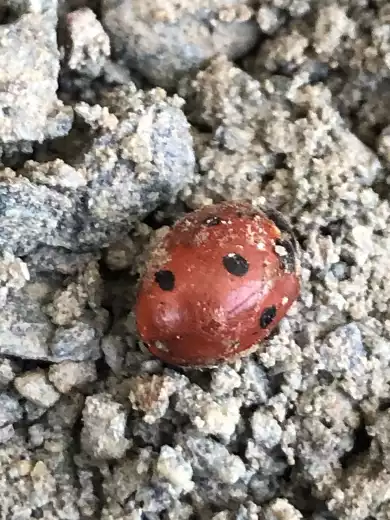
 Seven-spot ladybird — Coccinella septempunctata
Its role. Predator: larvae and adults feed on soft-bodied insects, insect eggs and especially aphids.
Link with the agro-ecosystem. The reference page (UC IPM) covers the convergent lady beetle, Hippodamia convergens, of the same family as the seven-spot: young larvae pierce and suck their prey, older larvae and adults chew it whole. Eggs are laid standing on end in clusters of about 10 to 30, near aphids or other prey. Adults gather in groups to overwinter, often on low vegetation in moist places.
Pace of life. Four stages (egg, larva with four instars, pupa, adult). According to UC IPM, a female can lay several hundred eggs over a life of about two months in the growing season, and there are two or more generations a year in California.
Sources : Convergent Lady Beetle — Natural Enemies Gallery (UC Statewide IPM Program (UC ANR))

 Common green lacewing — Chrysoperla carnea
Its role. The larvae prey on mites and soft-bodied insects (aphids, caterpillars, scales, thrips and others): they sink sharp mouthparts into the prey and suck out its contents. Adult Chrysoperla are not predators: they feed on honeydew, nectar and yeasts.
Link with the agro-ecosystem. Found in crops and gardens where there is prey and where flowers provide nectar or honeydew for the adults. In warm places all stages can be seen all year; where winters are cold it overwinters mostly as a last-instar larva or pupa inside a silken cocoon.
Pace of life. Four stages (egg, larva with three instars, pupa, adult). According to UC IPM, each female lays about 100 to 300 eggs over several weeks of life; egg to adult takes about 4 to 6 weeks in warm weather, with several generations a year.
Sources : Green Lacewing — Natural Enemies (UC Statewide IPM Program (UC ANR))
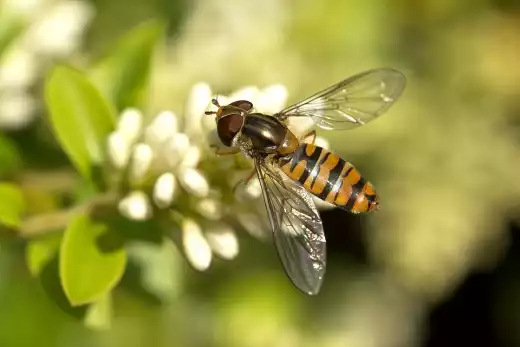
 Marmalade hoverfly — Episyrphus balteatus
Its role. Two roles: adults feed on nectar and pollen and pollinate flowers; the larvae of many hover flies prey on aphids and other sap-feeding insects.
Link with the agro-ecosystem. According to Cornell, females need pollen to produce viable eggs, and adults are efficient pollinators of many wild plants; because they do not provision nests, some species carry pollen farther than other pollinators. A single larva can eat up to 400 aphids during its development. Most hover flies overwinter in leaf litter. The source covers hover flies in general; the species photographed is Episyrphus balteatus.
Pace of life. According to Cornell, eggs hatch in about 3 days, larvae go through about 3 instars over 1 to 3 weeks and adults emerge in 1 to 2 weeks; there are five to seven generations a year unless the pupa overwinters.
Sources : Hover fly biocontrol fact sheet (Cornell IPM, January 2022) (Cornell Integrated Pest Management)
Reduced photo; source and licence on Wikimedia Commons.